
Project Case Study: Historic HVAC System Upgrade at Grant African Church
Project Overview
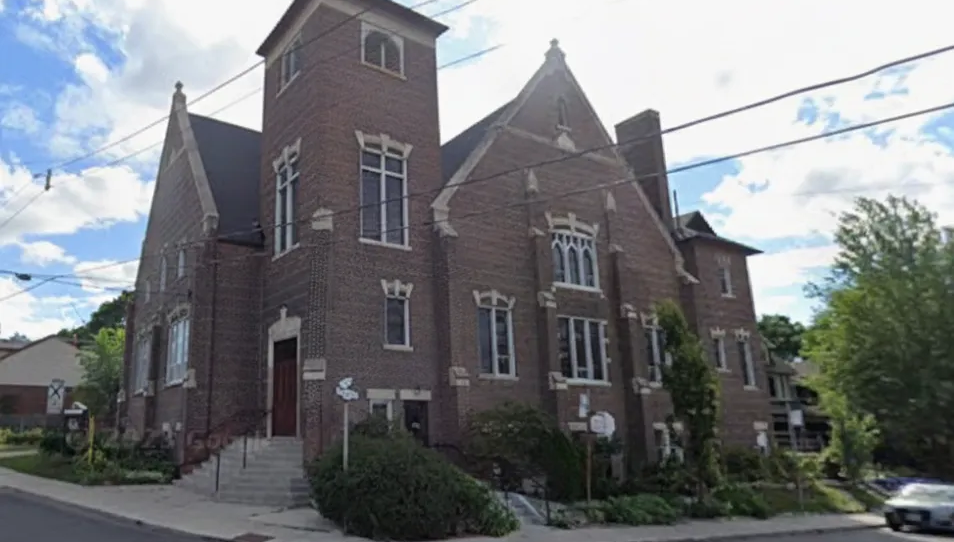
InnTech partnered with Marx Mechanical to deliver a specialized HVAC upgrade for the historic Grant African Methodist Episcopal Church on Gerrard Street in Toronto. Originally constructed in 1833, the church required a modern comfort solution capable of addressing severe heating and cooling deficiencies while preserving the integrity of its historic structure.
The project focused on improving comfort and efficiency in the main auditorium and adjacent spaces without major structural alterations. Through careful analysis and a layered system design, the team implemented a solution that restored reliable climate control, reduced operating costs, and respected the architectural and cultural significance of the building.
Project Location: 2029 Gerrard St E, Toronto, Ontario, Canada
Project Type: Major Renovation – Add-on Air Conditioning/Heating
Building Type: Institutional – Place of Worship
Technology: Daikin VRV, Daikin FIT Heat Pump, ICP Commercial Split Heat Pump & AHU
1. The Challenge
The church faced long-standing comfort and efficiency issues rooted in the limitations of its aging HVAC infrastructure and historic building envelope. The original steam boiler serving the main auditorium had failed and was beyond repair, and a like-for-like replacement was neither practical nor appropriate for the space. Existing attic-mounted air handling equipment provided limited cooling and relied on inefficient electric heaters for supplemental heating, resulting in poor performance and high operating costs.
Compounding these challenges, the church’s high ceilings, large open volume, and leaky envelope led to extremely high air change rates, causing conditioned air to escape rapidly and making it difficult to maintain consistent temperatures for a seating capacity of over 200 occupants. Any solution also needed to be implemented without invasive structural modifications, preserving the historic character of the building while overcoming the physical limitations of the space.
2. Our Solution
InnTech worked closely with Marx Mechanical to develop a technically rigorous, multi-system solution anchored by detailed heat gain and heat loss analysis. This upfront modeling established the true capacity required to overcome envelope losses and effectively condition the large auditorium volume, forming the basis for a tailored system design.
The resulting approach employed a three-layer conditioning strategy to deliver uniform comfort throughout the building. Base heating was provided from the basement level using two high-capacity furnaces and new ductwork, replacing the abandoned boiler system and leveraging the natural rise of warm air. For targeted cooling and zone-level control in the auditorium, a dedicated VRV system was introduced, utilizing Daikin VRV IV S outdoor units paired with strategically located wall-mounted indoor units along the perimeter walls.
To further improve overall efficiency and reliability, the existing attic air handlers were upgraded with modern commercial split heat pump systems, eliminating reliance on inefficient electric heating while maintaining appropriate backup capacity. This layered design allowed each system to operate within its optimal range, working together to address the building’s unique geometry and usage patterns without altering the structure itself. Due to the measurable peak energy savings achieved through the use of high-efficiency heat pump technology, the project qualified for SaveON Energy incentives, helping offset installation costs and improve the overall project economics for the church.
3. Results & Impact
The completed retrofit successfully restored comfortable, consistent conditions throughout the church, resolving long-standing heating and cooling challenges. The layered system design ensured uniform temperature distribution across the auditorium and surrounding spaces, even during peak occupancy and extreme weather conditions. By replacing a non-functional boiler and inefficient electric heating with modern heat pump-based systems, the church significantly improved energy efficiency and reduced operating costs. Equally important, all upgrades were completed without major structural changes, demonstrating that high-performance HVAC solutions can be thoughtfully integrated into historic buildings while preserving their architectural and cultural value.