
Project Case Study: VRF and Hydronic System Integration for a Custom Home.
Project Overview
InnTech partnered with Marx Mechanical to support the delivery of a high-end HVAC system for a new custom home in Richmond Hill, Ontario. While the original mechanical design met baseline requirements, the homeowner sought a more refined solution that delivered premium comfort, greater efficiency, and seamless system control.
Following the project bid, InnTech identified opportunities to further optimize the HVAC system. Through multiple site walk-throughs and close collaboration with the mechanical contractor and the engineer, the HVAC system was re-evaluated and refined. The final solution centered on a Daikin VRV system, thoughtfully integrated with the home’s hydronic radiant heating through a unified, staged control strategy.
Project Location: Richmond Hill, Ontario, Canada
Project Type: Residential New Construction – Low-rise
Building Type: Single Family Residential – Custom Home
Technology: Daikin VRV with compact ducted and ductless ceiling cassettes.
1. The Challenge
The project required careful coordination to evolve the original HVAC system design without compromising design intent, performance, or accountability. While the initial system selection was technically sound, it did not fully align with the homeowner’s expectations for control simplicity, operational flexibility, and long-term performance.
In addition, the home incorporated both air-side conditioning and in-floor radiant heating, introducing complexity around how these systems would interact. The hydronic system was designed by the project engineer and installed by the plumbing contractor, but effective operation depended on seamless integration with the HVAC controls, which fell under the mechanical contractor’s scope. Achieving a clear, intuitive control hierarchy without overlapping operation or inefficiency was a critical requirement.
2. Our Solution
After completing the project bid, InnTech worked alongside Marx Mechanical to conduct multiple site walk-throughs and reassess the HVAC approach in detail. Through this process, the team identified opportunities to refine the system layout and equipment selection to better align with the homeowner’s expectations for comfort, aesthetics, and operational simplicity. InnTech supported the redesign and re-selection of a Daikin VRV system that optimized comfort, efficiency and performance in each zone. Throughout this process, InnTech coordinated closely with the original design engineer to review and approve all changes prior to implementation.
To achieve a seamless interior aesthetic without compromising performance, the final design utilized a carefully coordinated mix of indoor unit types, including ductless wall-mounted units, four-way ceiling cassettes, and concealed ducted indoor units. This approach eliminated the need for bulky soffits or bulkheads, preserved ceiling heights, and allowed each space to be conditioned appropriately based on layout and usage. The result was a clean, unobtrusive HVAC integration that supported true room-by-room comfort control throughout the home.
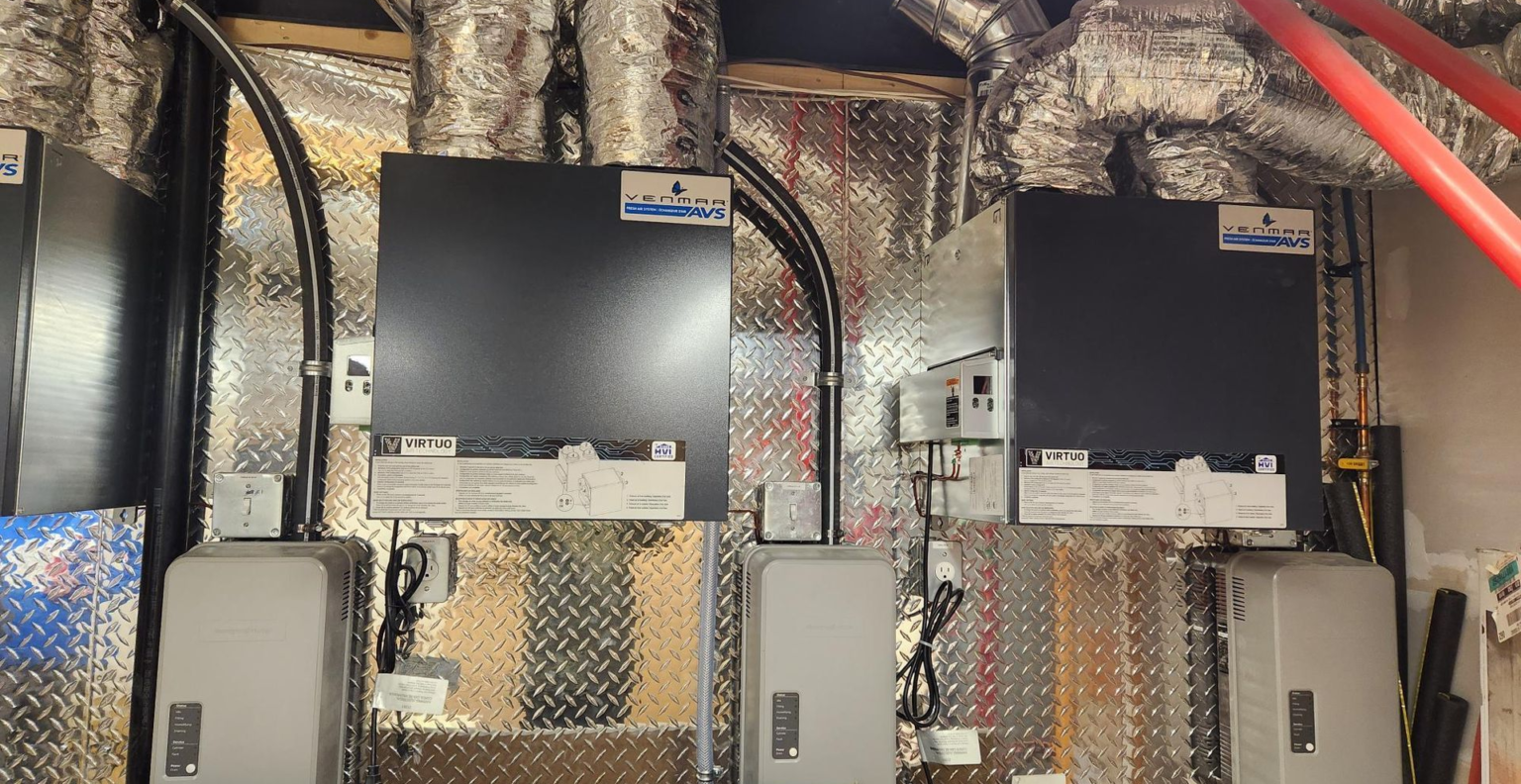
Ventilation was equally intentional. Fresh air was supplied through zone-dedicated ERVs, with ventilation air delivered directly through the concealed ducted and ceiling-mounted indoor units serving each zone. This ensured balanced, controlled ventilation without introducing additional grilles or visual clutter, while maintaining consistent indoor air quality across all occupied spaces.
While InnTech did not design the hydronic system itself, the team played a critical role in developing a custom controls integration strategy that aligned the air-side and radiant systems. Using Daikin central controls in combination with Tekmar zone controllers, the system was configured with a staged heating sequence: the Daikin VRV heat pumps operate as Stage 1 heating, providing efficient primary comfort, while the in-floor radiant heating system functions as Stage 2 heating, engaging only when required. This approach delivered a true single point of control, avoided system overlap, and ensured the home operated efficiently and intuitively.
3. Results & Impact
The redesigned HVAC system delivered a level of comfort, control, and performance consistent with the expectations of a high-end custom residence. The VRV system provides precise zoning and efficient modulation, while the staged integration with radiant heating ensures reliable comfort without unnecessary energy use or system overlap.
Through close collaboration, clear communication, and disciplined coordination with both the mechanical contractor and design engineer, the project team successfully navigated a complex redesign without disrupting construction progress. The homeowner benefited from a refined, future-ready mechanical system that balances performance, simplicity, and long-term reliability, reinforcing InnTech’s role as a trusted technical partner in complex residential projects.